
Following Donald Trump’s thunderous announcement on September 20th to increase H1B work visa fees to $100,000, it’s time to take stock. The news has caused intense panic and stress at airports and within companies that use this visa to recruit international talent.
NOW – THE ANNOUNCEMENT
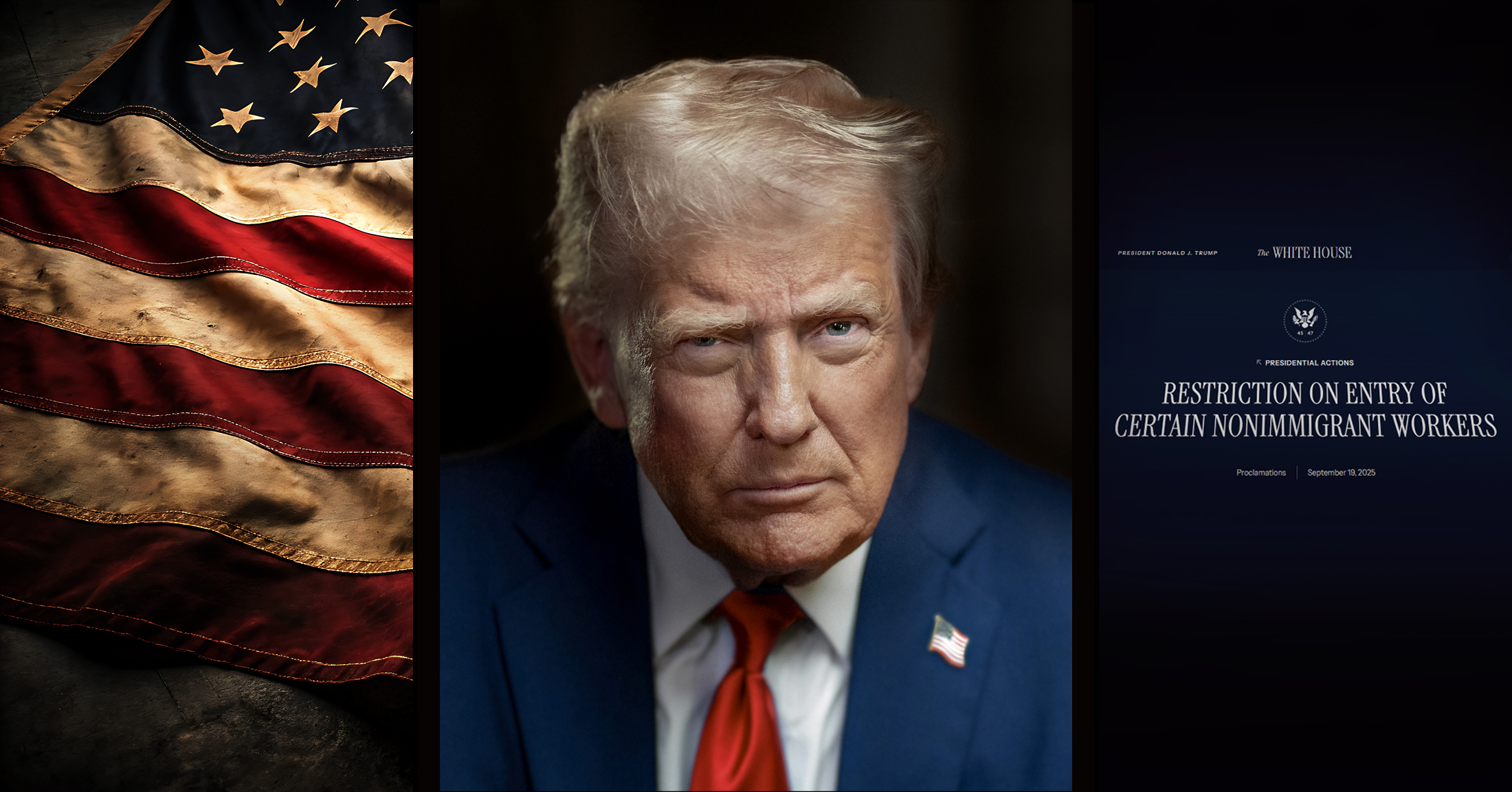
The announcement of the signing of the Proclamation “Restriction on Entry of Certain Nonimmigrant Workers” caught everyone by surprise. This text sets the “governmental fees” at $100,000 for any U.S. employer wishing to hire through the H1B program. However, as we now know, there is a difference between what Donald Trump announces and what the U.S. justice system validates.
His initial announcement indicated that any H1B applicant had to prove their employer had paid the $100,000 fee (a 1,200% increase). However, USCIS (the U.S. immigration authority) quickly tempered this statement. The agency clarified that this requirement only applies to petitions filed after September 21.
Therefore, petitions already filed, existing approvals, and currently valid visas are not affected. The situation regarding a change of employer is not yet specified in the official text.
In the same proclamation, the Department of Labor will increase the minimum wage required for this work permit. This measure is in line with the government’s desire to prioritize hiring American talent and to favor “the best of the best temporary foreign workers.” The current lottery system (which issues 85,000 visas per year) would operate differently, in order to prioritize candidates with the highest skills and salaries.
These announcements represent a cataclysm for the many companies (especially in tech, research, or healthcare) that use this program to recruit foreign talent. They could be challenged in court in the coming weeks. Currently, there are nearly 700,000 H1B holders in the United States, the majority from India and China. In 2024, more than 750,000 registrations were submitted for 85,000 slots. For the record, Elon Musk himself once held an H1B visa.
A stroke of genius or a very poor Trumpian strategy? The coming months will tell.
TOMORROW – WHAT ARE THE ALTERNATIVES?
If you wish to send talent to the United States, the H1B is not the only option, even if it is often the most suitable for recent graduates.
For professional mobility, you can also consider:
-
-
- The L1 “intra-company” work permit: It requires, among other conditions, 12 months of seniority within the same group and proven management or expert skills.
- The E2 work permit: It is based on a bilateral treaty between certain countries (including France) and the United States. The U.S. entity must be at least 50% owned by a citizen of a treaty country.
-
It will also be important to monitor the potential consequences for B1 and B1 in lieu of H1B visas. Fortunately, Donald Trump has thought of everything: he is considering proposing a “Gold Card” for one or two million dollars, and a “Trump Platinum Card” for 5 million.
WHAT ABOUT OTHER COUNTRIES?
In reaction to this announcement, China has announced the launch of the “Visa K,” aimed at young graduates in science, technology, engineering, and mathematics. A bachelor’s degree from a university recognized by Chinese authorities is the minimum requirement. This visa allows individuals to settle in China without a prior job contract. (More information from Oui Immigration is coming soon on this topic!)
IN SUMMARY
Donald Trump’s announcement creates a lot of uncertainty, but nothing is set in stone yet. It may be wise to start anticipating other solutions for your international mobility now. Indeed, Germany, South Korea, and the United Kingdom are also capitalizing on the arrival of foreign talent by offering new programs.
Our team is by your side to identify the best option. Contact us: oui@oui-immigration.com
PS: To learn more about the H1B: Focus on the US H1B – OUI Immigration. This article is from 2023 and does not take into account these new requirements.