
The H1B visa is one of the most popular and sought-after work permits for the United States. It allows U.S. companies to hire international talent for specialized positions. However, its process is complex and follows a very strict timeline.
Oui Immigration offers you a complete guide to understanding this essential American work permit.
What is the H1B Visa?
According to the U.S. Citizenship and Immigration Services (USCIS), the purpose of the H1B is to help employers who cannot find local talent. It allows them to temporarily hire qualified professionals from abroad. Companies often turn to this visa when an intra-company transfer via the L1 permit is not possible, particularly when there is no qualifying corporate relationship.
Here are its main features:
-
-
- It is a non-immigrant work permit with a limited duration (unlike a Green Card).
- It is tied to a specific employer, position, and location.
- Its initial duration is 3 years, and it is renewable once for a total of 6 years.
- After 5 years in H1B status, it is possible to apply for a Green Card.
-
Its popularity is immense: in 2022, USCIS received 308,613 petitions and issued 131,970 visas. India is the country with the most applicants, and companies like Google, Microsoft, and Amazon are among the top sponsors.
Eligibility Requirements
To be eligible for the H1B, the foreign professional must meet several criteria:
-
-
- Education: Hold at least a Bachelor’s degree (or its equivalent) related to the job, or have equivalent work experience.
- Skills: Be an expert in their field and be able to prove it.
- Job Offer: Provide evidence of a clear contractual relationship with a U.S. employer (employment contract, offer letter, etc.).
- Salary: The employer must commit to paying a wage that meets local standards for the position. The U.S. Department of Labor determines this wage by region to ensure that hiring a foreign national does not adversely affect the conditions of U.S. workers.
-
Furthermore, the employer must demonstrate that they could not find the required skills in the U.S. labor market.
Finally, the married spouse and children under 21 can obtain an H4B visa, a dependent status linked to the H1B for the same duration.
Timeline & Fees
The H1B process operates on a quota system and an annual lottery based on the U.S. fiscal year. Each year, the U.S. government allocates 65,000 H1B visas, plus an additional 20,000 visas for foreign nationals who have earned a master’s degree or higher from a U.S. university.
The typical timeline is as follows (based on the 2023 schedule):
-
-
- March: Online registration period to enter the lottery.
- Late March: USCIS conducts the random selection process.
- April to June: If the candidate is selected, the employer files the full H1B petition.
- Starting October 1st: The visa is issued by the Consulate, and employment can begin.
-
Government Fees
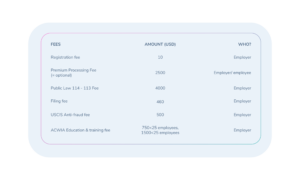
Here is an overview of the fees to consider for an application.
IMPORTANT NOTE: The fees listed below are from 2023. USCIS implemented a significant fee increase for most categories in 2024. Please contact us for the most up-to-date amounts.
What’s Next?
Once the visa is obtained, several situations should be anticipated:
-
-
- Renewal: After 3 years, the employer can request to renew the H1B for an additional 3 years.
- Job Loss: In case of termination, the visa holder has a 60-day grace period to find a new sponsoring employer.
- Path to the Green Card: After 5 years, it is possible to begin the process of obtaining permanent residency.
-
The H1B requires foresight and preparation. Once you get past the “luck” of the lottery, your petition must be prepared with extreme precision to avoid Requests for Evidence (RFEs).
To maximize your chances of success, use an expert to build your H1B petition. Contact us!